
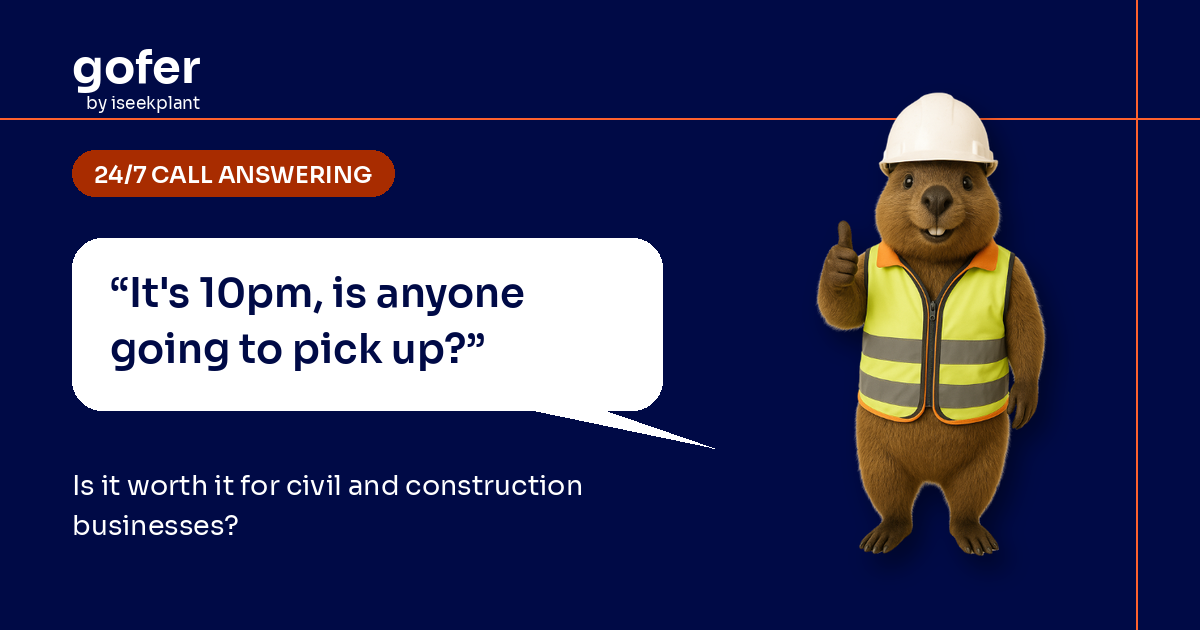
24/7 call answering for civil and construction businesses: is it worth it?

Lyndsey Jones • August 13, 2026

Is a 24/7 call answering service actually worth it for a civil or construction business? It's a fair question. Round-the-clock cover has a cost, and you might reasonably ask how many after-hours calls really justify it. The answer usually comes down to a simple sum: the cost of coverage versus the cost of the jobs you're currently missing.

Here's how to weigh up 24/7 call answering for a business that runs on site hours, not office hours.

In this article

What 24/7 call answering really means for site-based businesses

For an office-hours business, 24/7 answering can be overkill. For a civil or construction business, it often isn't — because your customers and your problems don't keep office hours.

Clients ring after work to plan jobs. Subbies call early to confirm access. Equipment fails on night shift. A lot of the calls that actually matter land outside nine to five, which is exactly when a standard office is closed.

The cost of after-hours coverage

With a human answering service, after-hours cover is where costs climb — overnight and weekend work attracts a premium, and you pay per call or per minute regardless of whether the call was worth taking.

With an AI receptionist, 24/7 cover is typically included in a flat monthly fee. There's no penalty rate for a 2am call, which changes the maths considerably — the cost of "always on" is fixed and predictable rather than climbing with every out-of-hours call.

The cost of a missed after-hours job

Now the other side of the ledger. What's a missed after-hours enquiry actually worth? For most civil and construction businesses, a single job runs well into the thousands — sometimes far more.

If even one after-hours call a month turns into a job you'd otherwise have lost, that usually covers the cost of round-the-clock answering several times over. The missed-call maths is rarely close.

Doing the maths for a civil business

The honest way to decide is to estimate two numbers: how many enquiries you currently miss outside hours, and the average value of a job. Multiply them out and compare against the flat cost of 24/7 cover.

For most site-based businesses, the missed-job figure dwarfs the cost of coverage. This is general guidance rather than financial advice, but the exercise is quick and usually settles the question. Broader planning tools on business.gov.au can help you frame it.

When 24/7 answering pays off

It pays off when your enquiries genuinely come in after hours, when a captured job is worth far more than the monthly fee, and when missing calls is costing you work you'll never hear about. For most civil and construction businesses, all three are true.

Gofer includes 24/7 answering as standard, built for the trade. See how Gofer Receptionist works, or book a free demo and work out the numbers for your business.

Recent posts

By Caitlin Fraser August 18, 2026
Arborist business software should start with the phone. See how structured lead capture qualifies tree and concreting jobs — access, scope and site conditions.
By Caitlin Fraser August 15, 2026
AI for tradies in 2026: where it genuinely helps Australian construction and civil businesses reclaim lost hours — and why generic AI tools fall short for the trade.
By Michael Lyons August 12, 2026
How much does a virtual receptionist cost in Australia? Compare per-call, per-minute and flat monthly pricing, and work out the ROI against one captured job.
Show more posts
By Caitlin Fraser August 18, 2026
Arborist business software should start with the phone. See how structured lead capture qualifies tree and concreting jobs — access, scope and site conditions.
By Caitlin Fraser August 15, 2026
AI for tradies in 2026: where it genuinely helps Australian construction and civil businesses reclaim lost hours — and why generic AI tools fall short for the trade.
Show more posts